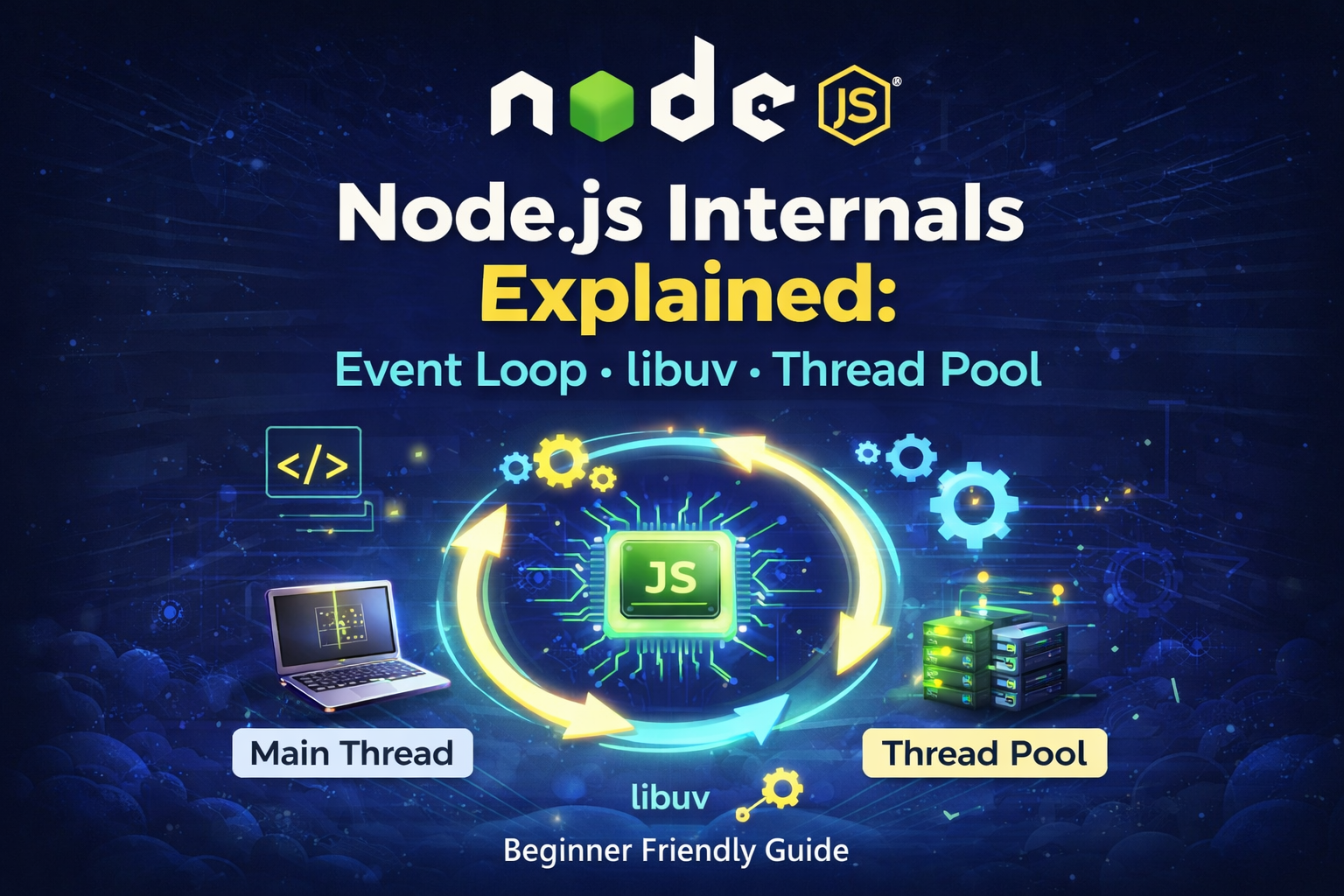
Backend Engineering Series #1: Node.js Architecture Explained
i am learner whatever i will learn i will write here
Welcome to the Backend Engineering Series.
In this series we will explore how backend systems actually work — from the basics of Node.js architecture to the internals of the event loop and asynchronous programming.
In this first article, we will understand the architecture of Node.js and how it enables high-performance, non-blocking applications.
Node.js Architecture Explained (Super Easy Guide)
Before learning the Event Loop, it is very important to understand Node.js Architecture.
Because the Event Loop is just one part of Node.js.
If you understand the architecture, the rest of Node.js concepts become much easier.
So let's understand how Node.js works internally.
1. JavaScript Cannot Run by Itself
JavaScript needs something called a JavaScript Engine to run.
Example engines:
| Platform | Engine |
|---|---|
| Chrome | V8 |
| Firefox | SpiderMonkey |
| Node.js | V8 |
Node.js uses Google's V8 Engine.
The V8 engine:
reads JavaScript code
converts it into machine code
runs the program
Example:
console.log("Hello Node.js")
When you run:
node app.js
the V8 engine executes this code.
2. Node.js Is More Than Just V8
Node.js is not just the V8 engine.
It combines three main components:
V8 Engine
C++ bindings
libuv
Each part has a different job.
3. C++ Bindings (Node APIs)
Node.js provides many built-in APIs like:
fs (file system)
http (server)
crypto
timers
Example:
const fs = require("fs")

fs.readFile("data.txt",(err,data)=>{
 console.log(data)
})
When we call fs.readFile(), JavaScript actually calls C++ code inside Node.js, which talks to the operating system.
This is how Node.js interacts with your computer.
4. libuv (The Most Important Part)
Node.js uses a library called libuv.
libuv handles things like:
asynchronous operations
file system tasks
networking
event loop
thread pool
libuv is the reason Node.js can handle many operations without blocking the program.
5. Node.js Uses a Single Thread
Node.js runs JavaScript on one main thread.
This means JavaScript executes one task at a time.
Example:
console.log("Start")

for(let i=0;i<1000000000;i++){}

console.log("End")
The loop blocks the program.
This is called blocking code.
Blocking code is bad for servers because it stops other users from being served.
6. Non-Blocking Architecture
Node.js solves this problem using asynchronous programming.
Instead of waiting for slow tasks like:
reading files
database queries
API calls
Node.js sends these tasks to libuv.
While the task is running, Node.js continues doing other work.
When the task finishes, the result is returned as a callback.
Example:
fs.readFile("file.txt",(err,data)=>{
 console.log(data)
})
Node.js does not wait for the file to finish reading.
7. Thread Pool
Node.js also has something called a thread pool.
Default size:
4 threads
These threads handle heavy tasks like:
file system operations
cryptography
compression
DNS lookup
Example:
const crypto = require("crypto")

crypto.pbkdf2("password","salt",100000,1024,"sha256",()=>{
 console.log("Done")
})
This heavy operation runs in the thread pool, not in the main thread.
8. How Node.js Handles a Request
Let's imagine a user sends a request to a Node.js server.
The flow looks like this:
User Request
     ↓
Node.js Server
     ↓
JavaScript Code Runs
     ↓
Async Task Sent to libuv
     ↓
Thread Pool Handles Task
     ↓
Result Returned
     ↓
Callback Executes
Because Node.js does not block the main thread, it can handle many requests at the same time.
9. Why Node.js Is Fast
Node.js is fast because it uses:
single thread execution
non-blocking I/O
asynchronous architecture
thread pool for heavy tasks
This allows Node.js to handle thousands of connections efficiently.
CONCLUSION
Important things to remember:
Node.js uses the V8 engine to run JavaScript
Node.js APIs are implemented using C++ bindings
libuv handles asynchronous operations
Node.js uses a thread pool for heavy tasks
Node.js follows a non-blocking architecture
Because of this design, Node.js can build fast and scalable backend applications.